
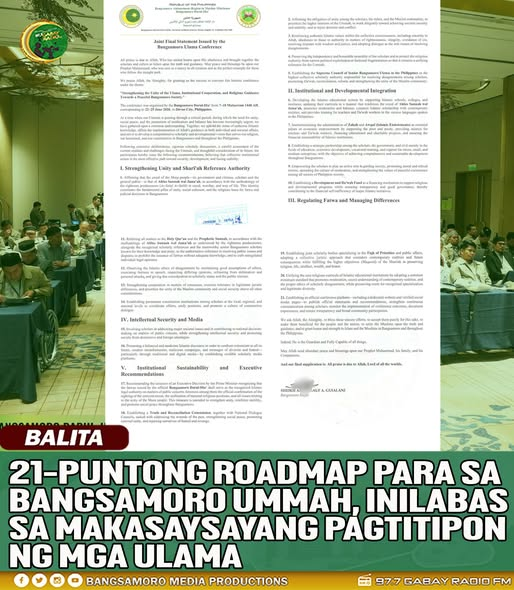
Isang makasaysayang hakbang tungo sa higit na pagkakaisa ng Muslim Ummah ang nabuo matapos magtipon ang mga iginagalang na ulama at Islamic scholars mula sa iba’t ibang bahagi ng rehiyon upang pagtibayin ang isang Joint Final Statement na naglalaman ng kanilang nagkakaisang pananaw para sa kinabukasan ng Bangsamoro.
Bunga ng ilang araw na makabuluhang talakayan, scholarly deliberation, at taos-pusong konsultasyon, inilatag ng mga ulama ang 21 komprehensibong rekomendasyon na magsisilbing gabay sa pagtugon sa mahahalagang usaping panrelihiyon, panlipunan, at pangkaunlaran ng Bangsamoro Ummah.
Basahin ang buong Joint statement
JOINT FINAL STATEMENT ISSUED BY THE BANGSAMORO ULAMA CONFERENCE
All praise is due to Allah, Who has united hearts upon His obedience and brought together the scholars and callers to Islam upon the truth and guidance. May peace and blessings be upon our Prophet Muhammad, who was sent as a mercy to all creation and as the perfect example for those who follow the straight path.
We praise Allah, the Almighty, for granting us the success to convene this historic conference under the theme:
“Strengthening the Unity of the Ulama, Institutional Cooperation, and Religious Guidance Towards a Peaceful Bangsamoro Society.”
The conference was organized by the Bangsamoro Darul-Ifta’ from 7–10 Muharram 1448 AH, corresponding to 22–25 June 2026, in Davao City, Philippines.
At a time when our Ummah is passing through a critical period, during which the need for unity, social peace, and the promotion of moderation and balance has become increasingly urgent, we have gathered upon a common understanding. Together, we uphold the status of authentic Islamic knowledge, affirm the implementation of Allah’s guidance in both individual and societal affairs, and strive to develop a comprehensive scholarly and developmental vision that serves our religion, our homeland, and our communities in Bangsamoro and throughout the Philippines.
Following extensive deliberations, rigorous scholarly discussions, a careful assessment of the current realities and challenges facing the Ummah, and thoughtful consideration of its future, the participants hereby issue the following recommendations, believing that collective institutional action is the most effective path toward security, development, and lasting stability.
I. Strengthening Unity and Sharī‘ah Reference Authority
1. Affirming that the creed of the Moro people—its government and citizens, scholars and the general public—is that of Ahlus Sunnah wal Jama’ah, in accordance with the methodology of the righteous predecessors (As-Salaf As-Salih) in creed, worship, and way of life. This identity constitutes the fundamental pillar of unity, social cohesion, and the religious basis for fatwa and judicial decisions in Bangsamoro.
2. Affirming the obligation of unity among the scholars, the rulers, and the Muslim community, to prioritize the higher interests of the Ummah, to work diligently toward achieving societal security and stability, and to reject division and conflict.
3. Reinforcing authentic Islamic values within the collective consciousness, including sincerity to Allah, obedience to those in authority in matters of righteousness, integrity, avoidance of sin, resolving disputes with wisdom and justice, and adopting dialogue as the sole means of resolving disagreements.
4. Preserving the independence and honorable neutrality of the scholars and to protect the religious authority from narrow political exploitation or factional fragmentation so that it remains a unifying reference for the Ummah.
5. Establishing the Supreme Council of Senior Bangsamoro Ulama in the Philippines as the highest collective scholarly authority responsible for resolving disagreements among scholars, promoting Da’wah, reconciliation, reform, and strengthening the unity of the Muslim community.
II. Institutional and Developmental Integration
6. Developing the Islamic educational system by supporting Islamic schools, colleges, and institutes; updating their curricula in a manner that reinforces the creed of Ahlus Sunnah wal Jama’ah, promotes moderation and balance, connects Islamic scholarship with contemporary realities, and provides training for teachers and Da’wah workers in the various languages spoken in the Philippines.
7. Institutionalizing the administration of Zakah and Awqaf (Islamic Endowments) as essential pillars of economic empowerment by supporting the poor and needy, providing salaries for teachers and Da’wah workers, financing educational and charitable projects, and ensuring the financial sustainability of Islamic institutions.
8. Establishing a strategic partnership among the scholars, the government, and civil society in the fields of education, economic development, vocational training, and support for micro, small, and medium enterprises, with the objective of achieving comprehensive and sustainable development throughout Bangsamoro.
9. Empowering the scholars to play an active role in guiding society, promoting moral and ethical reform, spreading the culture of moderation, and strengthening the values of peaceful coexistence among all sectors of Philippine society.
10. Establishing a Development and Da’wah Fund as a financing mechanism to support religious and developmental programs while ensuring transparency and good governance, thereby contributing to the financial self-sufficiency of major Islamic initiatives.
III. Regulating Fatwa and Managing Differences
11. Referring all matters to the Holy Qur’an and the Prophetic Sunnah, in accordance with the methodology of Ahlus Sunnah wal Jama’ah as understood by the righteous predecessors, alongside the recognized scholarly references and the trustworthy senior Bangsamoro scholars known for their knowledge and piety, as the authoritative reference in resolving public issues and disputes; to prohibit the issuance of fatwas without adequate knowledge; and to curb unregulated individual legal opinions.
12. Observing the Islamic ethics of disagreement by maintaining good assumptions of others, exercising fairness in speech, respecting differing opinions, refraining from defamation and personal attacks, and giving due consideration to scholarly status and the public interest.
13. Strengthening cooperation in matters of consensus, exercise tolerance in legitimate juristic differences, and prioritize the unity of the Muslim community and social security above all other considerations.
14. Establishing permanent consultation mechanisms among scholars at the local, regional, and national levels to coordinate efforts, unify positions, and promote a culture of constructive dialogue.
IV. Intellectual Security and Media
15. Involving scholars in addressing major societal issues and in contributing to national decision-making on matters of public concern, while strengthening intellectual security and protecting society from destructive and foreign ideologies.
16. Promoting a balanced and moderate Islamic discourse in order to confront extremism in all its forms, counter misinformation, malicious campaigns, and messages of division and hatred—particularly through traditional and digital media—by establishing credible scholarly media platforms.
V. Institutional Sustainability and Executive Recommendations
17. Recommending the issuance of an Executive Decision by the Prime Minister recognizing that the fatwas issued by the official Bangsamoro Darul-Ifta’ shall serve as the recognized Islamic legal authority on matters of public concern, foremost among them the official confirmation of the sighting of the crescent moon, the unification of national religious positions, and all issues relating to the unity of the Moro people. This measure is intended to strengthen unity, reinforce stability, and promote social peace throughout Bangsamoro.
18. Establishing a Truth and Reconciliation Commission, together with National Dialogue Councils, tasked with addressing the wounds of the past, strengthening social peace, promoting national unity, and rejecting narratives of hatred and revenge.
19. Establishing joint scholarly bodies specializing in the Fiqh of Priorities and public affairs, adopting a collective juristic approach that considers contemporary realities and future consequences while fulfilling the higher objectives (Maqasid) of the Shari’ah in preserving religion, life, intellect, wealth, and honor.
20. Unifying the core religious curricula of Islamic educational institutions by adopting a common minimum standard that promotes moderation, sound understanding of contemporary realities, and the proper ethics of scholarly disagreement; while preserving room for recognized specialization and legitimate diversity.
21. Establishing an official conference platform—including a dedicated website and verified social media pages—to publish official statements and recommendations, strengthen continuous communication among scholars, monitor the implementation of conference outcomes, document experiences, and ensure transparency and broad community participation.
We ask Allah, the Almighty, to bless these sincere efforts, to accept them purely for His sake, to make them beneficial for the people and the nation, to unite the Muslims upon the truth and guidance, and to grant honor and strength to Islam and the Muslims in Bangsamoro and throughout the Philippines.
Indeed, He is the Guardian and Fully Capable of all things.
May Allah send abundant peace and blessings upon our Prophet Muhammad, his family, and his Companions.
And our final supplication is: All praise is due to Allah, Lord of all the worlds.
SHEIKH ABDULRAUF A. GUIALANI



 Views Today : 43
 Views Yesterday : 145
 Views Last 7 days : 805
 Views Last 30 days : 3761
 Views This Month : 3158
 Views This Year : 29752
 Total views : 41887
Leave a Reply